Regresar
Contenido del curso
First Period
Our First Term Adventure: English Grade 3Welcome to a very special first term! This year, we aren't just memorizing words; we are learning how to tell our own stories. Our classroom will be a place where we use our bodies to mime actions, our hands to draw our ideas, and our voices to bring rhymes to life. Here is a look at the journey we’ll take together over the next few weeks:We’ll start by focusing on who we are. The children will learn how to greet the world at different times of the day and, most importantly, how to share their feelings. Whether they are feeling "happy," "surprised," or "brave," they’ll find the right words to express it while getting to know their classmates.Next, we’ll become explorers of our own space. We will use colors and numbers (1–20) to describe everything around us. It’s not just about saying "pencil"—it’s about describing "three yellow pencils." This helps the students see the classroom through a new lens, noticing the details and quantities in their everyday environment.Our journey then takes us into the heart of the home and the wild. We’ll talk about the people we love—our families—and the animals we admire. By using words like "My" and "Your," and sharing what we "Like" or "Don't like," the children will learn to communicate their affections and their unique personalities.Finally, we will wrap up the term by becoming "Daily Reporters." We’ll look at our lives from sunrise to sunset, learning how to describe our routines—from eating breakfast to playing with friends. By using action verbs and talking about how often we do things, students will gain the confidence to talk about their real-life habits.By the end of this term, your child won’t just be "learning English"—they will be living it, using the language to connect with others, express their creativity, and describe the beautiful world they live in.
0/4
SECOND PERIOD
In this comprehensive pedagogical sequence, students will embark on a journey that moves from the intimate setting of the home to the active classroom environment, culminating in a global exploration of wildlife. Each stage is designed to build linguistic confidence through kinesthetic activities, artistic expression, and critical thinking.📍 Thematic Pillars & Learning Milestones Theme 1: Identity & Foundations – "My Family & Me at Breakfast" Concept: The breakfast table as a ritual of connection and history.Linguistic Focus: Family vocabulary, breakfast items, Spelling Bee rules, and WH- Questions (Who, What, Where).Key Activities: * Alphabet Family Tree: Blending genealogy with spelling mastery.Breakfast Detectives: Using grammar to analyze family morning routines.Global Breakfast Mural: An infographic exploring cultural culinary differences.Theme 2: My Immediate Environment – "Let's Eat at School!" Concept: The classroom as a shared ecosystem of learning and nutrition.Linguistic Focus: School objects, lunchbox vocabulary, and existence structures (There is / There are).Key Activities:3D Lunchbox Design: Using paper folding to label and categorize food and supplies.The Surprise Bag: A "teacher-for-a-day" roleplay to practice singular vs. plural.Hygiene Posters: Creating classroom signs using Demonstratives (This, That, These, Those) to promote order.Theme 3: Exploring the World – "Into the Wild" Concept: Developing global responsibility through wildlife observation.Linguistic Focus: Wild animals, habitats, and environmental ethics.Key Activities:Wild City in a Box: Constructing habitat models to report animal existence.Virtual Safari: Using cardboard binoculars to practice distal demonstratives (Those).Animal Welfare Debate: Discussing captivity vs. freedom and writing conservation pledges.🎯 Pedagogical Goals & Transversal Skills Grammar in Context: Mastering the mechanics of There is/are and WH- Questions through real-world scenarios.Civic Responsibility: From cleaning a desk to protecting a lion, students learn their role in maintaining their environment.Collaborative Learning: Co-evaluations and group projects like the "Safari in the Classroom" foster a supportive community.📊 Final Assessment & Closing (September) The period concludes with a high-engagement finale:The Big Challenge (Sept 08): A points-based competition covering all three units.Family & Food Portfolio (Sept 07): A curated collection of the student's best work, decorated with a personal self-evaluation.Wildlife Expert Badges: A symbolic recognition of the student's growth in vocabulary, fluency, and environmental awareness.Final Reflection: The journey ends with a healthy snack and a "Gala of Achievements," where we celebrate the transition from learning names to protecting nature.
0/3
English Third Grade

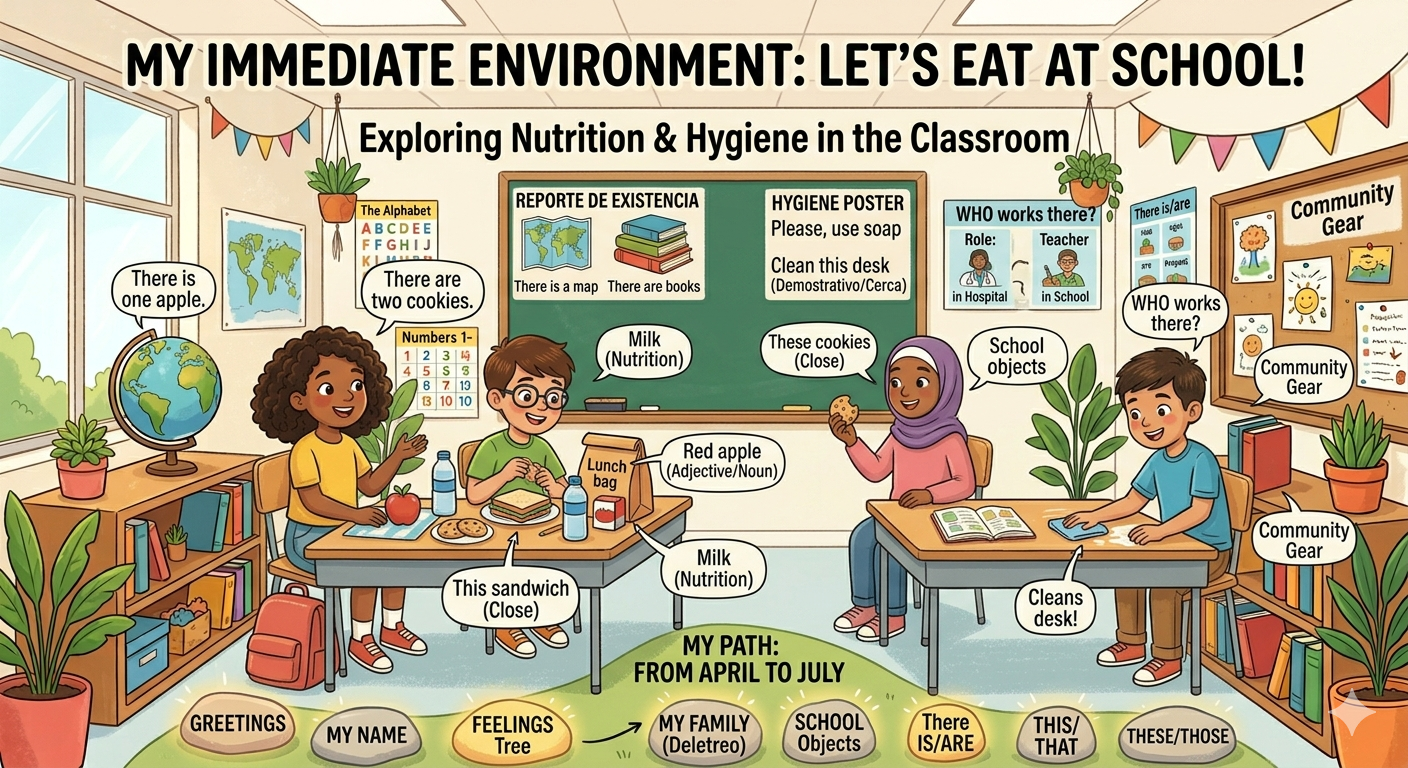
TEMA 2: MY IMMEDIATE ENVIRONMENT: LET’S EAT AT SCHOOL!

Concepto: El salón de clases es un ecosistema donde conviven el aprendizaje y la nutrición. Usar There is/are y los demostrativos permite al estudiante apropiarse de su entorno, entendiendo que el orden y la higiene son actos de respeto común. Objetivo: Reconocer objetos escolares y alimentos de la lonchera, reportando su existencia mediante There is/There are y demostrativos.

Fecha: Lunes 04 de mayo del 2026

Actividad: «El Espía del Salón». Usamos lupas de papel para buscar objetos específicos que la docente nombra. En la segunda hora, iniciamos el «Mapa de Coordenadas»: los niños dibujan su pupitre y etiquetan los 4 objetos que tienen más cerca.

Fecha: Martes 05 de mayo del 2026

Actividad: «Simon Says: Classroom Edition». Comandos de acción con objetos («Pick up the pencil», «Touch the board»). En la segunda hora, creamos un «Móvil de Vocabulario» con dibujos de objetos escolares para las ventanas.

Fecha: Miércoles 06 de mayo del 2026

Actividad: «La Tienda de Útiles». Simulamos una compra: «Can I have a red pen, please?». En la segunda hora, registran una lista de «Precios Imaginarios», practicando números y nombres de objetos.

Fecha: Lunes 11 de mayo del 2026

Actividad: «Introducción a las Preposiciones». Usamos cajas para mostrar In, On, Under. En la segunda hora, dibujan tres escenas en el cuaderno ilustrando dónde está un objeto respecto a la mesa.

Fecha: Martes 12 de mayo del 2026

Actividad: «Escondite de Objetos». La docente esconde un borrador y da pistas: «It is under the chair». En la segunda hora, resuelven un laberinto visual en el cuaderno escribiendo la ubicación de los objetos.

Fecha: Miércoles 13 de mayo del 2026

Actividad: «Mi Salón en 3D». Moldeamos objetos del salón con plastilina. En la segunda hora, los ubicamos en un cartón con etiquetas: «The pencil is ON the desk».

Fecha: Lunes 18 de mayo del 2026

Actividad: «El Dictado Loco». Dibujar lo que la docente dice: «There is a blue ruler on the floor». En la segunda hora, comparan dibujos para corregir errores de ubicación y color.

Fecha: Martes 19 de mayo del 2026

Actividad: «Gallery Walk de Objetos». Exposición de útiles. Los niños caminan y dicen: «This is a notebook». En la segunda hora, crean un minilibro de «Mis tesoros escolares».

Fecha: Miércoles 20 de mayo del 2026

Actividad: «Bingo de Ubicación». La docente dice posiciones: «The pen is IN the bag». Cerramos con una canción rítmica sobre preposiciones.

Fecha: Lunes 25 de mayo del 2026

Actividad: «Repaso de Plurales». Cómo cambian los objetos de uno a muchos (Pencil -> Pencils). En la segunda hora, clasificamos recortes en columnas: «One» y «Many».

Fecha: Martes 26 de mayo del 2026

Actividad: «El Inventario del Inspector». Cuentan cuántos objetos hay en su fila. En la segunda hora, grafican los resultados con barras de colores en el cuaderno.

Fecha: Miércoles 27 de mayo del 2026

Actividad: «Cierre de Mayo: Mi Lugar Favorito». Dibujan su rincón preferido y escriben: «There is a chair. The book is on the table.»

Fecha: Lunes 01 de junio del 2026

Actividad: Lluvia de ideas visual: «La hora de la merienda». Clasificamos objetos y alimentos. En la segunda hora, lista bilingüe ilustrada para decorar el puesto.

Fecha: Martes 02 de junio del 2026

Actividad: Búsqueda del tesoro: «Find a red apple». En la segunda hora, registran hallazgos trabajando la concordancia (Red apple, Green book).

Fecha: Miércoles 03 de junio del 2026

Actividad: Bingo de la Lonchera (útiles y comida). En la segunda hora, diseño de «Lonchera Ideal» en 3D etiquetando lo que «hay» dentro.

Fecha: Jueves 04 de junio del 2026

Actividad: Repaso Pre-Vacaciones con juego de «Stop». En la segunda hora, nota de despedida a sus útiles mencionando qué se queda y qué va a casa.

Fecha: Lunes 06 de julio del 2026

Actividad: «La Bolsa Sorpresa» para explicar There is/There are. En la segunda hora, los niños juegan a ser profesores preguntando al grupo.

Fecha: Martes 07 de julio del 2026

Actividad: Inventario de Lonchera Real: «There is one sandwich, there are two cookies». En la segunda hora, mapa conceptual sobre nutrición.

Fecha: Miércoles 08 de julio del 2026

Actividad: Introducción a Demostrativos (This, That, These, Those). En la segunda hora, pegan etiquetas adhesivas diciendo la frase según la distancia.

Fecha: Jueves 09 de julio del 2026

Actividad: Cartel de Higiene escolar. Diseñamos pósteres: «Clean this desk!». En la segunda hora, decoramos y pegamos los mensajes en el aula.