Regresar
Contenido del curso
First Period
Our First Term Adventure: English Grade 3Welcome to a very special first term! This year, we aren't just memorizing words; we are learning how to tell our own stories. Our classroom will be a place where we use our bodies to mime actions, our hands to draw our ideas, and our voices to bring rhymes to life. Here is a look at the journey we’ll take together over the next few weeks:We’ll start by focusing on who we are. The children will learn how to greet the world at different times of the day and, most importantly, how to share their feelings. Whether they are feeling "happy," "surprised," or "brave," they’ll find the right words to express it while getting to know their classmates.Next, we’ll become explorers of our own space. We will use colors and numbers (1–20) to describe everything around us. It’s not just about saying "pencil"—it’s about describing "three yellow pencils." This helps the students see the classroom through a new lens, noticing the details and quantities in their everyday environment.Our journey then takes us into the heart of the home and the wild. We’ll talk about the people we love—our families—and the animals we admire. By using words like "My" and "Your," and sharing what we "Like" or "Don't like," the children will learn to communicate their affections and their unique personalities.Finally, we will wrap up the term by becoming "Daily Reporters." We’ll look at our lives from sunrise to sunset, learning how to describe our routines—from eating breakfast to playing with friends. By using action verbs and talking about how often we do things, students will gain the confidence to talk about their real-life habits.By the end of this term, your child won’t just be "learning English"—they will be living it, using the language to connect with others, express their creativity, and describe the beautiful world they live in.
0/4
SECOND PERIOD
In this comprehensive pedagogical sequence, students will embark on a journey that moves from the intimate setting of the home to the active classroom environment, culminating in a global exploration of wildlife. Each stage is designed to build linguistic confidence through kinesthetic activities, artistic expression, and critical thinking.📍 Thematic Pillars & Learning Milestones Theme 1: Identity & Foundations – "My Family & Me at Breakfast" Concept: The breakfast table as a ritual of connection and history.Linguistic Focus: Family vocabulary, breakfast items, Spelling Bee rules, and WH- Questions (Who, What, Where).Key Activities: * Alphabet Family Tree: Blending genealogy with spelling mastery.Breakfast Detectives: Using grammar to analyze family morning routines.Global Breakfast Mural: An infographic exploring cultural culinary differences.Theme 2: My Immediate Environment – "Let's Eat at School!" Concept: The classroom as a shared ecosystem of learning and nutrition.Linguistic Focus: School objects, lunchbox vocabulary, and existence structures (There is / There are).Key Activities:3D Lunchbox Design: Using paper folding to label and categorize food and supplies.The Surprise Bag: A "teacher-for-a-day" roleplay to practice singular vs. plural.Hygiene Posters: Creating classroom signs using Demonstratives (This, That, These, Those) to promote order.Theme 3: Exploring the World – "Into the Wild" Concept: Developing global responsibility through wildlife observation.Linguistic Focus: Wild animals, habitats, and environmental ethics.Key Activities:Wild City in a Box: Constructing habitat models to report animal existence.Virtual Safari: Using cardboard binoculars to practice distal demonstratives (Those).Animal Welfare Debate: Discussing captivity vs. freedom and writing conservation pledges.🎯 Pedagogical Goals & Transversal Skills Grammar in Context: Mastering the mechanics of There is/are and WH- Questions through real-world scenarios.Civic Responsibility: From cleaning a desk to protecting a lion, students learn their role in maintaining their environment.Collaborative Learning: Co-evaluations and group projects like the "Safari in the Classroom" foster a supportive community.📊 Final Assessment & Closing (September) The period concludes with a high-engagement finale:The Big Challenge (Sept 08): A points-based competition covering all three units.Family & Food Portfolio (Sept 07): A curated collection of the student's best work, decorated with a personal self-evaluation.Wildlife Expert Badges: A symbolic recognition of the student's growth in vocabulary, fluency, and environmental awareness.Final Reflection: The journey ends with a healthy snack and a "Gala of Achievements," where we celebrate the transition from learning names to protecting nature.
0/3
English Third Grade

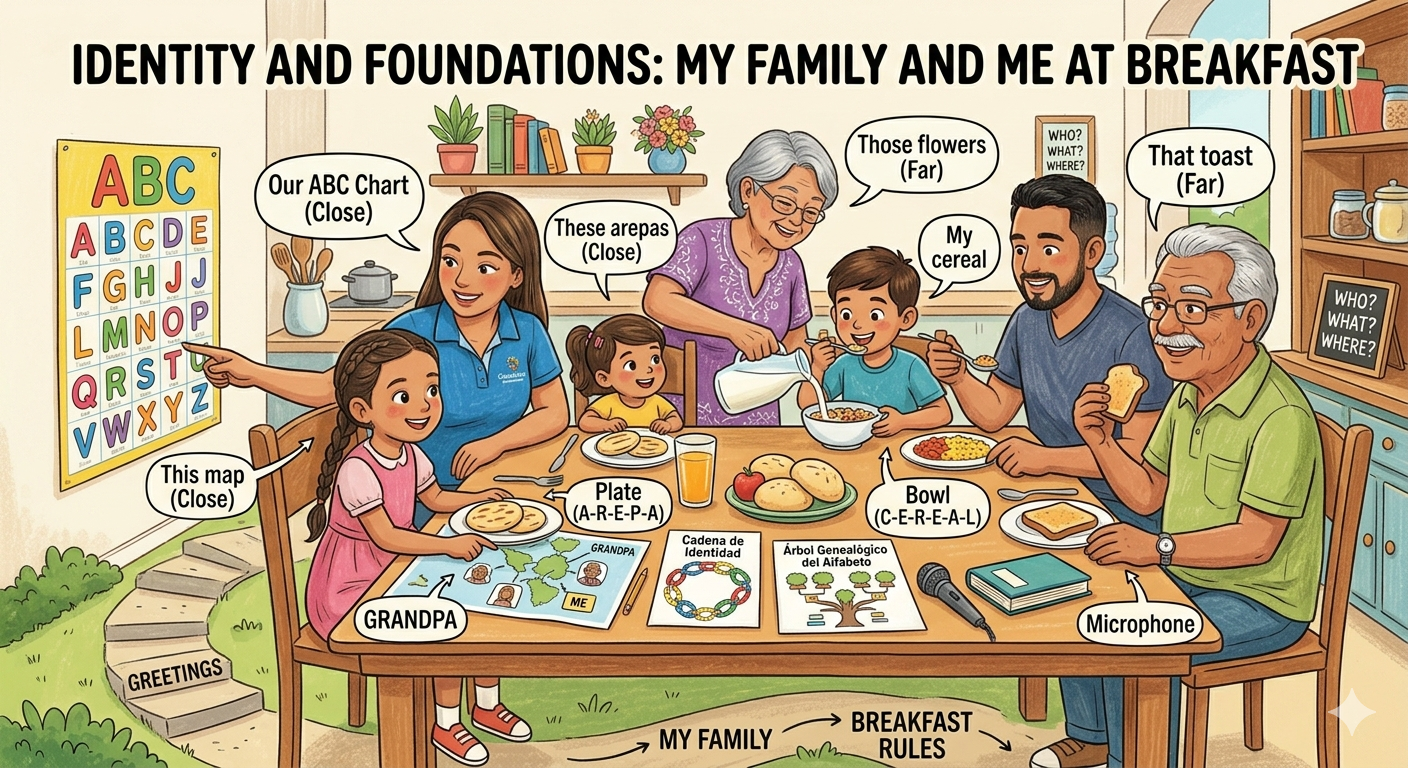
TEMA 1: IDENTITY AND FOUNDATIONS: MY FAMILY AND ME AT BREAKFAST

Concepto: El desayuno en familia es un ritual de conexión donde el lenguaje nos
permite reconocer roles y necesidades. Al preguntar Who, What y Where, los niños
aprenden a interesarse por los demás y a valorar su propia historia desde la mesa
de su hogar.

Objetivo: Identificar a los miembros de la familia y alimentos del desayuno,
aplicando reglas de deletreo y preguntas WH- para describir rutinas matutinas.

Fecha: Lunes 20 de abril del 2026
Actividad: Iniciamos con el «Spelling Bee Familiar». Repasamos el abecedario
rítmicamente y practicamos deletreando parentescos (Mother, Father, Sister). En la
segunda hora, hacemos un concurso por equipos deletreando los nombres reales
de sus familiares; cerramos decorando el «Árbol Genealógico del Alfabeto» en el
cuaderno.

Fecha: Martes 21 de abril del 2026
Actividad: Menú de «My Family Breakfast». Presentamos vocabulario de alimentos
(Eggs, Milk, Cereal). Los niños clasifican lo saludable y lo que no. En la segunda
hora, construyen una ficha donde dibujan a un familiar y escriben: «My father eats
eggs», terminando con mímicas para adivinar desayunos.

Fecha: Miércoles 22 de abril del 2026
Actividad: Los Detectives del Desayuno. Introducimos Who, What y Where.
Jugamos a «Emparejamiento Gigante» uniendo preguntas con respuestas lógicas.
En la segunda hora, dibujan una mesa de desayuno y etiquetan 3 preguntas
diferentes sobre la escena para fomentar el análisis gramatical.

Fecha: Jueves 23 de abril del 2026
Actividad: Taller «This is my home». Practicamos la estructura «This is my…» usando
fotos o dibujos familiares en parejas. En la segunda hora, Se describe un desayuno
y los niños deben dibujarlo exactamente como lo escuchan, trabajando el
seguimiento de instrucciones.

Fecha: Lunes 27 de abril del 2026
Actividad: «Family Connections». Charlamos sobre la importancia de nuestra
historia. Los niños crean una «Cadena de Identidad» con datos de sus familiares. En
la segunda hora, presentan sus cadenas al grupo usando oraciones completas,
trabajando la fluidez y el respeto por la diversidad.

Fecha: Martes 28 de abril del 2026
Actividad: Desayunos del Mundo. Viajamos virtualmente para ver qué desayunan
en otros países. En la segunda hora, divididos en grupos, crean una sección de una
infografía mural gigante titulada «Breakfast around the world», usando recortes y
descripciones cortas sobre diferencias culturales.

Fecha: Miércoles 29 de abril del 2026
Actividad: Juego de Asociación WH-. Desafío de velocidad para unir preguntas
desordenadas. En la segunda hora, jugamos a la «Pregunta Saltarina»: lanzamos
una pelota y quien la atrapa responde una pregunta de Sharon sobre su familia,
promoviendo la respuesta rápida.

Fecha: Jueves 30 de abril del 2026
Actividad: Cierre de Comprensión. Recolectamos las ideas de la unidad en un
mapa conceptual colorido. En la segunda hora, redactan un párrafo corto
describiendo su momento favorito del desayuno, usando preguntas WH- para
cuestionar a su lector imaginario.