English Fifth Grade
Acerca de este curso
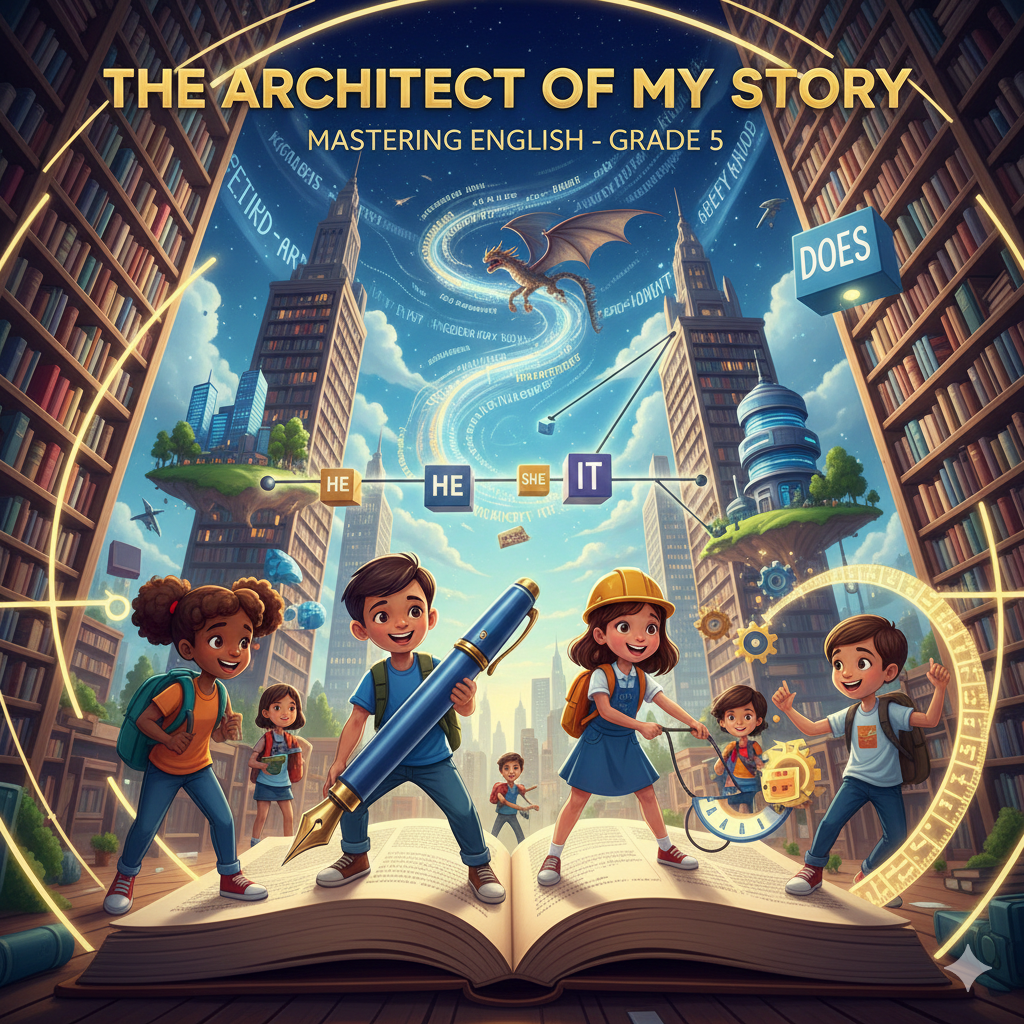
Welcome to a higher level of communication! In 5th Grade, English evolves from simple vocabulary into a tool for leadership and personal narrative. This course is designed to help students transition from speaking in isolated phrases to building cohesive, logical, and detailed accounts of their lives. We are not just learning a language; we are learning how to architect our own reality in a global world.
What Will I Learn?
The first term is a journey through time and identity, structured into three powerful modules:
Mastering Daily Life (Present Simple & Routine): Students will learn to organize their immediate reality. We will master the logic of «Third Person» rules and auxiliary verbs (Do/Does) to describe habits, universal truths, and daily schedules with professional precision.
The Art of Detail (Descriptive Adjectives & Attributes): We will expand our world beyond the basic. Students will learn to characterize people, objects, and places with rich, academic vocabulary. By the end of this module, they will be able to create «Multidimensional Portraits,» describing not just how something looks, but its personality, function, and atmosphere.
Navigating Time (Past & Future Temporalities): Students will gain a linear vision of time. They will learn to look back at their history using the Past Simple (mastering the mystery of regular and irregular verbs) and look forward to their goals using the «Going to» structure. This allows them to narrate experiences and plan their academic future with total autonomy.
¿Qué aprenderás?
- ¡Este periodo elevarás tu nivel de comunicación! Aprenderás a ser el dueño de tu propio relato en inglés. Primero, dominarás la lógica de las rutinas, aprendiendo a usar los auxiliares (Do/Does) y las reglas de la tercera persona para describir hábitos con precisión técnica. Luego, te convertirás en un maestro del detalle, utilizando adjetivos avanzados para caracterizar personas, lugares y objetos. Finalmente, aprenderás a viajar en el tiempo, conectando tus recuerdos del pasado (verbos regulares e irregulares) con tus metas y planes futuros usando la estructura Going to.
Contenido del curso
First Period
Here is a clear and professional summary of the First Term for 5th Grade, structured to highlight the progression of skills from basic routines to complex storytelling.First Term Summary: The Narrative Journey
In this first period, our 5th-grade students will transition from basic sentence structures to becoming active storytellers. The term is strategically divided into three phases that build upon each other to create a solid linguistic foundation.Phase 1: The Logic of Routine (Present Simple)
The journey begins by mastering the "engine" of the English language. Students will learn to organize their daily reality by describing habits and universal truths.Key Focus: Accuracy in the "Third Person" rules (He, She, It) and the confident use of auxiliary verbs (Do/Does) for questions and denials.Outcome: By late February, students will be able to present their own weekly schedules and discuss frequency using specialized vocabulary like always, sometimes, and never.Phase 2: The Art of Detail (Descriptive Power)
Once students can describe what they do, they will learn to describe how things are. This phase focuses on expanding their academic vocabulary through adjectives.Key Focus: Characterizing people (physical and personality traits), places (atmosphere and location), and objects (technical attributes).Outcome: Students will create multidimensional portraits and technical data sheets, moving beyond simple adjectives to rich, detailed descriptions.Phase 3: Mastering Time (Past & Future)
The term concludes with a focus on temporal flexibility. Students will learn to navigate the timeline of their lives with precision.Key Focus: Distinguishing between Past Simple (Regular and Irregular verbs) to narrate experiences, and the "Going to" structure to plan for the future.Outcome: The final project involves a "Projected Agenda" and a personal narrative of past events, demonstrating the ability to communicate fluently across different timeframes.
Second Period
THIRD PERIOD
The core concept of this theme states that the regularity of our actions defines our lifestyle and character. By exploring how often activities are performed, students develop self-analysis and time-management skills, utilizing precise grammatical tools to communicate daily habits, hobbies, and community responsibilities. The objective is to express the frequency of daily and community activities using frequency adverbs like always, usually, sometimes, and never, as well as present tense auxiliaries like do and does, while structuring surveys and analytical reports on group behavior.The activities begin on Monday, July 6, 2026, with a post-vacation return activity titled "My Time Management," which features a visual brainstorming session on daily routines followed by the introduction of the frequency adverb scale, where students create a percentage bar in their notebooks to associate each adverb with its regularity. On Tuesday, July 7, 2026, the driving question "How often do you...?" is introduced, explaining that the adverb goes before the main verb, and students build a biographical chart detailing real routines at home. On Thursday, July 9, 2026, the "Auxiliary Mechanics Workshop (Do / Does)" takes place to analyze how frequency questions change in the third person singular, and students start designing a "Frequency Journal" using recycled paper to write their first five hypotheses about their classmates' habits. On Monday, July 13, 2026, a research dynamic called "Classroom Census" allows students to move around the room conducting guided surveys, and during the second hour, they consolidate the responses statistically in their field diaries using third-person sentences. Finally, on Tuesday, July 14, 2026, the "Healthy Habits Chart" activity helps students classify daily activities as beneficial or harmful based on their frequency, wrapping up with a comparative paragraph that contrasts physical activity and rest using basic connectors.Theme 2: Actions in Progress and Emotions: What Are You Doing?
The underlying concept emphasizes that the present is a constant stage for action and change. Understanding ongoing activities using the Present Continuous alongside an honest expression of feelings allows students to describe immediate realities, which strengthens group empathy and emotional intelligence. The objective is to describe actions in progress and simultaneous emotional states using the present continuous tense and feeling adjectives, applying prepositions of place and indefinite articles like a and an with structural precision.The schedule resumes on Monday, August 3, 2026, with a moving brainstorming session called "Actions in Real Time," where gerund verb cards are presented for students to perform chained mimics while the rest of the group reports what they see. On Tuesday, August 4, 2026, the emotional connection "How are you feeling while...?" introduces feeling vocabulary like happy, tired, excited, angry, and sad, leading to the creation of complex sentences that link ongoing actions with emotions. On Thursday, August 6, 2026, a "Spatial Geometry Workshop" explains how to specify exact locations using in, on, under, next to, and behind, which students apply by completing an illustrated map of a living school. On Monday, August 10, 2026, the "Snapshot Reporters" activity turns students into live journalists describing complex city photos on the board and writing a formal report in their notebooks using the subject, verb to be, gerund, and preposition formula. On Tuesday, August 11, 2026, students engage in the graphic construction of "The Living Comic Strip," designing a four-panel comic where a character goes through different moods while doing activities, adding dialogue bubbles that combine the present continuous and feeling adjectives.Theme 3: Contrasting Time: Present vs. Past Histories
This theme is based on the concept that personal and community history connects current actions with past experiences. Contrasting the present with the past using temporal auxiliaries provides students with a solid mental framework to narrate historical events, travel chronicles, or family anecdotes with temporal propriety. The objective is to differentiate the use of the grammatical auxiliaries do and does for the present versus did for the past in interrogative and negative contexts, writing short stories about habit changes and completed activities.The lessons start on Thursday, August 13, 2026, with an introduction to the grammatical time tunnel through the auxiliary "Did," analyzing how questions about routines transform when referring to yesterday or last year, and concluding with a comparative technical chart on the board tabulating the functions of do/does versus did. On Monday, August 17, 2026, the activity "My Ancestors' Routines" analytically investigates past routines compared to modern technological life, and students structure written dialogues in pairs to compare eras. On Tuesday, August 18, 2026, the "Syntactic Restructuring Workshop" features practical board exercises where children act as language mechanics to detect tense errors and correct base verbs when "Did" is present, followed by a speed and spelling accuracy competition. On Thursday, August 20, 2026, a reading comprehension session on "An Archaeologist's Diary" analyzes a scientist's excavation activities, and students extract past tense sentences to create a visual glossary. On Monday, August 24, 2026, a transition and autonomous production activity requires children to transform a paragraph about current weekly habits into a report of activities completed the previous week, followed by a cross-correction session. On Tuesday, August 25, 2026, a conversational simulation named "Unsolved Mysteries" tasks small groups with assuming detective roles to interrogate peers about past actions. On Thursday, August 27, 2026, a practical comprehensive review workshop distributes worksheets with mixed sentences containing the present continuous, prepositions, and time auxiliaries, consolidating general doubts about the simple past structure.Theme 4: Integration Semester Project: The Time Travelers' Documentary
The concept notes that language mastery is consolidated when students integrate present actions, habit frequencies, and historical contrasts. This final project acts as an evidence portfolio that demonstrates grammatical maturity and readiness for the next academic year. The objective is to produce and defend, both orally and in writing, a historical simulation documentary that integrates frequency adverbs, the present continuous, feelings, and the auxiliaries do, does, and did.The project launches on Monday, August 31, 2026, with "The Time Travelers' Documentary," where students organize into research groups, define their script themes, and write the first section detailing their character's daily routine frequency. On Tuesday, September 1, 2026, they structure Chapter 2, "Actions in the Present," writing a live-action scene with gerunds, exact prepositions of place, and indefinite articles. On Thursday, September 3, 2026, they integrate Chapter 3, "Looking into the Past," formally including the auxiliary "Did" to narrate historical events, followed by a review of temporal coherence. On Monday, September 7, 2026, a graphic design lab opens for producing backgrounds, props, and visual concept maps while assembling the portfolio. On Tuesday, September 8, 2026, an intensive phonetics and public speaking workshop helps groups practice fluent reading, focusing on gerund pronunciation and auxiliary question intonation. On Thursday, September 10, 2026, a timed dress rehearsal evaluates the use of physical resources and communicative clarity. The oral presentations take place during the Grand Gala Sustentation Day 1 on Monday, September 14, 2026, and Day 2 on Tuesday, September 15, 2026, where oral fluency, timeline alternation, and peer feedback are assessed.Post-Project Consolidation and Formative Closure
Following the Institutional Recess Week from October 5 to October 16, the pedagogical return begins on Monday, October 19, 2026, with a post-project linguistic analysis workshop on the board to identify strong structures and recurrent grammatical errors. On Tuesday, October 20, 2026, "The Ultimate Language Trivia" marathon serves as a comprehensive points competition covering free-time activities, feelings, adverbs, and indefinite articles. On Thursday, October 22, 2026, a final written evaluative workshop applies a diagnostic reading comprehension and text production test focused on do, does, and did. On Monday, October 26, 2026, group feedback and co-evaluation of the written exam take place on the board to resolve conceptual gaps. On Tuesday, October 27, 2026, a reading and complex text analysis session interprets short stories that combine daily descriptions and past tales. On Thursday, October 29, 2026, a notebook consolidation workshop lets students write an autonomous personal reflective diary comparing their skills from the beginning of the year against their current abilities. On Monday, November 2, 2026, a formative closure involves the exhaustive review and return of portfolios and diaries graded with detailed rubrics. On Tuesday, November 3, 2026, a projective workshop titled "My Linguistic Future" asks students to map out self-learning goals for the next educational level. The entire period concludes on Thursday, November 5, 2026, with an academic closing day and achievement celebration, featuring the screening of a bilingual educational short film and a collective reflection on the fluency, technical vocabulary, and perseverance demonstrated by the fifth-grade group throughout the 2026 school year.
Valoraciones y reseñas de estudiantes