
Regresar
Contenido del curso
First Period
The first academic term of 4th Grade English is designed as a foundational journey that transitions students from basic word recognition to conscious, structured language production. This period focuses on empowering students to navigate different social environments, organize their thoughts through time, and decode information with independence.The curriculum is structured around three core pillars of linguistic development:1. Social & Pragmatic Competence The term begins with Linguistic Structures and Oral Interaction. Students will explore the "Social Mirror," learning to adapt their speech between formal and informal registers. This stage goes beyond simple greetings, focusing on technical classroom commands, polite inquiry, and the use of precise descriptive language. The goal is for students to understand that language is a tool for building respectful and clear social connections.2. Narrative Logic & Temporality In the second phase, Morphosyntax and Verbal Temporality, the focus shifts to the internal logic of the language. Students will master the ability to "travel through time" by differentiating between facts (Present Simple), memories (Past Simple), and projections (Future with Will). By aligning subjects and verbs correctly, students will move from isolated sentences to coherent narratives, gaining the ability to tell stories that are logically and chronologically organized.3. Critical Literacy & Inferred Meaning The term concludes with Lexical Acquisition and Contextual Inference. This pillar is dedicated to fostering "Textual Autonomy." Rather than relying on constant translation, students are trained to use "context clues," word roots, and reading strategies like Scanning and Skimming. This develops the critical thinking skills necessary to process intermediate-level texts and expand their vocabulary through logical deduction rather than rote memorization.
0/3
SECOND PERIOD
Unit Overview: 2nd Period – "Moving Through My World" In this second unit, students will expand their horizons by exploring transportation, community roles, and environmental awareness. Moving beyond personal feelings, they will now learn to describe the dynamic "gears" that make their society function.Through an active and kinesthetic approach, children will analyze the speed and utility of different ways to travel, using the Present Continuous and Simple Present (Do/Does) to describe actions happening in real-time and daily habits, such as "The bus is moving through the city" or "Does she wear a raincoat in the rain?"They will also discover the community as a living engine, identifying public places and the professions that inhabit them. By using Prepositions of Place and Movement (Next to, Between, Go straight), students will navigate their own "Interactive Neighborhood Maps" and connect these spaces to their own families' needs and desires, expressing preferences with "I want" and "I like."This period focuses on civic responsibility and critical thinking, encouraging students to compare transportation methods based on their environmental impact and practice values in public spaces. By the end of the unit, students will not only use English to communicate but also to project themselves as active citizens who understand their city, plan family adventures, and value their role within the community.
0/3
English Fourth Grade.

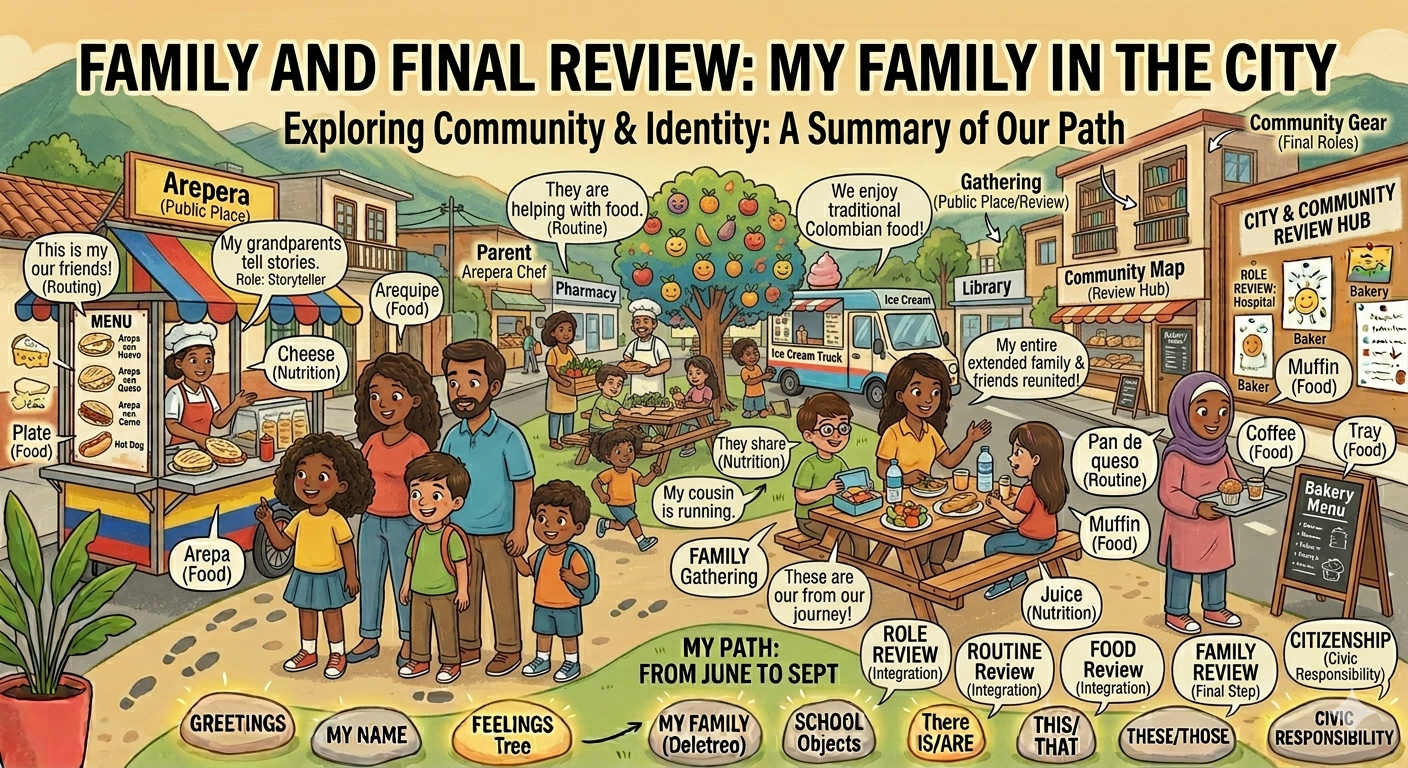
TEMA 3: FAMILY AND FINAL REVIEW: MY FAMILY IN THE CITY

Concepto: La familia es el núcleo que se mueve y consume en la ciudad. Integrar
todos los temas anteriores permite describir nuestra realidad social completa:
quiénes somos, cómo nos movemos y qué nos gusta hacer juntos en comunidad.
Objetivo: Describir roles familiares, rutinas de transporte y preferencias en la
ciudad, integrando el uso de Do/Does, WH- Questions y preposiciones para
planificar experiencias familiares.

Fecha: Lunes 10 de agosto de 2026
Actividad: Repaso de los miembros de la familia y sus ocupaciones o roles. En la
segunda hora, nombramos las actividades que cada pariente realiza en la ciudad
usando el vocabulario de transporte visto en la Unidad 1.

Fecha: Martes 11 de agosto de 2026
Actividad: Los niños entrevistan a sus compañeros sobre el transporte de sus
padres. En la segunda hora, consolidan los datos y presentan los resultados usando oraciones completas: «Does your dad take the train? Yes, he does».

Fecha: Lunes 17 de agosto de 2026
Actividad: Explicamos las preferencias de los miembros de la familia (My mom
likes… My dad doesn’t like…) mediante un árbol genealógico de gustos. En la
segunda hora, conectamos esos gustos con lugares favoritos de la ciudad.

Fecha: Martes 18 de agosto de 2026
Actividad: Los niños dibujan el lugar favorito de su familia. En la segunda hora,
escriben las direcciones detalladas para llegar desde su casa usando preposiciones
de movimiento aprendidas (Turn right, Cross the street).

Fecha: Lunes 24 de agosto de 2026
Actividad: Planificamos una salida familiar imaginaria. Deben detallar el transporte
usado y la comida elegida. En la segunda hora, preparan una presentación visual
(un cartel promocional del viaje) sobre esta experiencia.

Fecha: Martes 25 de agosto de 2026
Actividad: Discutimos cómo comportarse en lugares públicos (valores familiares).
En la segunda hora, diseñan un cartel sobre «Family Values in Public Places» usando frases cortas en inglés.

Fecha: Lunes 31 de agosto de 2026
Actividad: Comparamos las rutinas de transporte de dos familias diferentes del
salón en un cuadro técnico. En la segunda hora, Sharon evalúa el uso correcto de
Do/Does mediante un juego de tarjetas rápidas.

Fecha: Martes 01 de septiembre de 2026
Actividad: Practicamos diálogos que integren WH- Questions y auxiliares en
contextos familiares. En la segunda hora, realizamos un taller de evaluación
formativa preparando el guion para el proyecto final del video.

Fecha: Lunes 07 de septiembre de 2026
Actividad: Charla y redacción de un párrafo sobre por qué la familia es importante
en la comunidad. En la segunda hora, los grupos de proyecto final ensayan sus
diálogos para el video de cierre.

Fecha: Martes 08 de septiembre de 2026
Actividad: Los niños ejecutan el proyecto final: «The Family Adventure Video».
Simulan un viaje familiar por la ciudad aplicando todos los temas. Se supervisa
y califica la aplicación integral de gramática, vocabulario y pronunciación.